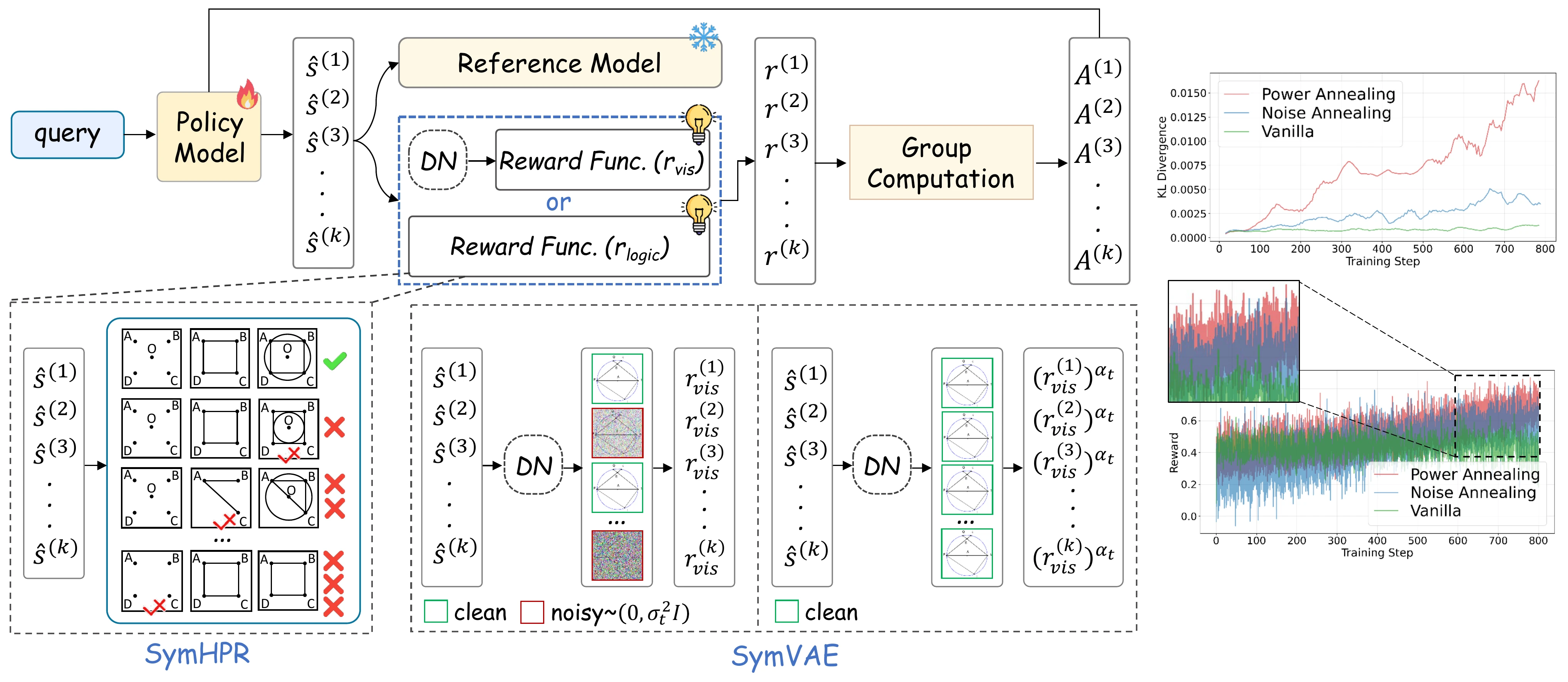
Symbolic computer vision represents diagrams through explicit logical rules and structured representations, enabling interpretable understanding in machine vision. This requires fundamentally different learning paradigms from pixel-based visual models. Symbolic visual learners parse diagrams into geometric primitives—points, lines, and shapes—whereas pixel-based learners operate on textures and colors. We propose a novel self-supervised symbolic auto-encoder that encodes diagrams into structured primitives and their interrelationships within the latent space, and decodes them through our executable engine to reconstruct the input diagrams. Central to this architecture is SymHPR (Symbolic Hierarchical Process Reward Modeling), which applies hierarchical step-level parsing rewards to enforce point-on-line, line-on-shape, and shape-on-relation consistency.
Evaluations across reconstruction, perception, and reasoning tasks demonstrate the effectiveness of our approach: achieving a 98.2% reduction in MSE for geometric diagram reconstruction, surpassing GPT-4o by 0.6% with a 7B model on chart reconstruction, improving by +13% on the MathGlance perception benchmark, and by +3% on MathVerse and GeoQA reasoning benchmarks.
Our auto-encoder uses a rendering engine as decoder that reconstructs diagrams from symbolic logic forms. This enables self-supervised training through perceptual loss between input diagrams and their reconstructions. To address training collapse due to sparse supervision, we introduce two stabilization strategies:
We evaluate our symbolic auto-encoder (SymVAE) across three tasks: geometric diagram reconstruction, diagram understanding, and mathematical reasoning.
| Model | Synthetic Diagrams | Geo170K Diagrams | ||||||
|---|---|---|---|---|---|---|---|---|
| MSE↓ | LPIPS↓ | SSIM↑ | DINO↑ | MSE↓ | LPIPS↓ | SSIM↑ | DINO↑ | |
| Pixel-Level Auto-Encoder | ||||||||
| VAE | 12.9 | 0.29 | 0.62 | 0.81 | 37.9 | 0.37 | 0.64 | 0.80 |
| VQ-GAN | 11.7 | 0.21 | 0.69 | 0.81 | 37.2 | 0.31 | 0.73 | 0.83 |
| Close-Source MLLMs | ||||||||
| GPT-4o | 34.3 | 0.15 | 0.82 | 0.96 | 39.9 | 0.22 | 0.76 | 0.92 |
| Our Symbolic Models | ||||||||
| SymParser-3B | 7.64 | 0.12 | 0.76 | 0.93 | 36.8 | 0.28 | 0.76 | 0.93 |
| SymHPR-3B | 7.02 | 0.08 | 0.83 | 0.96 | 27.7 | 0.26 | 0.77 | 0.95 |
| SymVAE-3B | 6.13 | 0.01 | 0.89 | 0.95 | 21.8 | 0.20 | 0.79 | 0.95 |
| SymVAE-7B | 6.01 | 0.05 | 0.94 | 0.96 | 16.8 | 0.17 | 0.83 | 0.96 |
We evaluate on the MathGlance benchmark covering plane geometry, solid geometry, and graphs.
| Model | Size | Avg. | Plane Geo. | Solid Geo. | Graphs |
|---|---|---|---|---|---|
| GPT-4o | - | 53.3 | 42.8 | 60.7 | 56.4 |
| GPT-o4-mini-high | - | 48.0 | 19.1 | 64.7 | 60.1 |
| Qwen2.5-VL | 7B | 59.2 | 44.0 | 63.1 | 65.7 |
| Math-LLaVA | 13B | 40.0 | 27.9 | 44.8 | 47.3 |
| Primitive | 7B | 46.6 | 35.4 | 49.4 | 55.1 |
| SymVAE+GeoPeP | 7B | 72.6 | 77.9 | 67.6 | 72.2 |
| Model | All | Vision Int. | Vision Only |
|---|---|---|---|
| G-LLaVA-7B | 16.6 | 17.2 | 9.4 |
| Math-LLaVA-13B | 24.1 | 17.6 | 16.4 |
| MAVIS-7B | 28.4 | 24.7 | 18.3 |
| Qwen2.5-VL-7B | 49.2 | 33.2 | 21.1 |
| SymVAE+CoTs-7B | 51.8 | 35.2 | 24.9 |
| Model | Accuracy (%) |
|---|---|
| G-LLaVA-7B | 64.2 |
| MAVIS-7B | 66.7 |
| MultiMath-7B | 74.1 |
| Qwen2.5-VL-7B | 76.4 |
| SymVAE+CoTs-7B | 79.4 |
Comparison of geometric reconstructions between our approach and general-purpose multimodal models. General-purpose multimodal models struggle to preserve fine-grained geometric structure, whereas our approach yields substantially more faithful geometric and relational reconstructions.
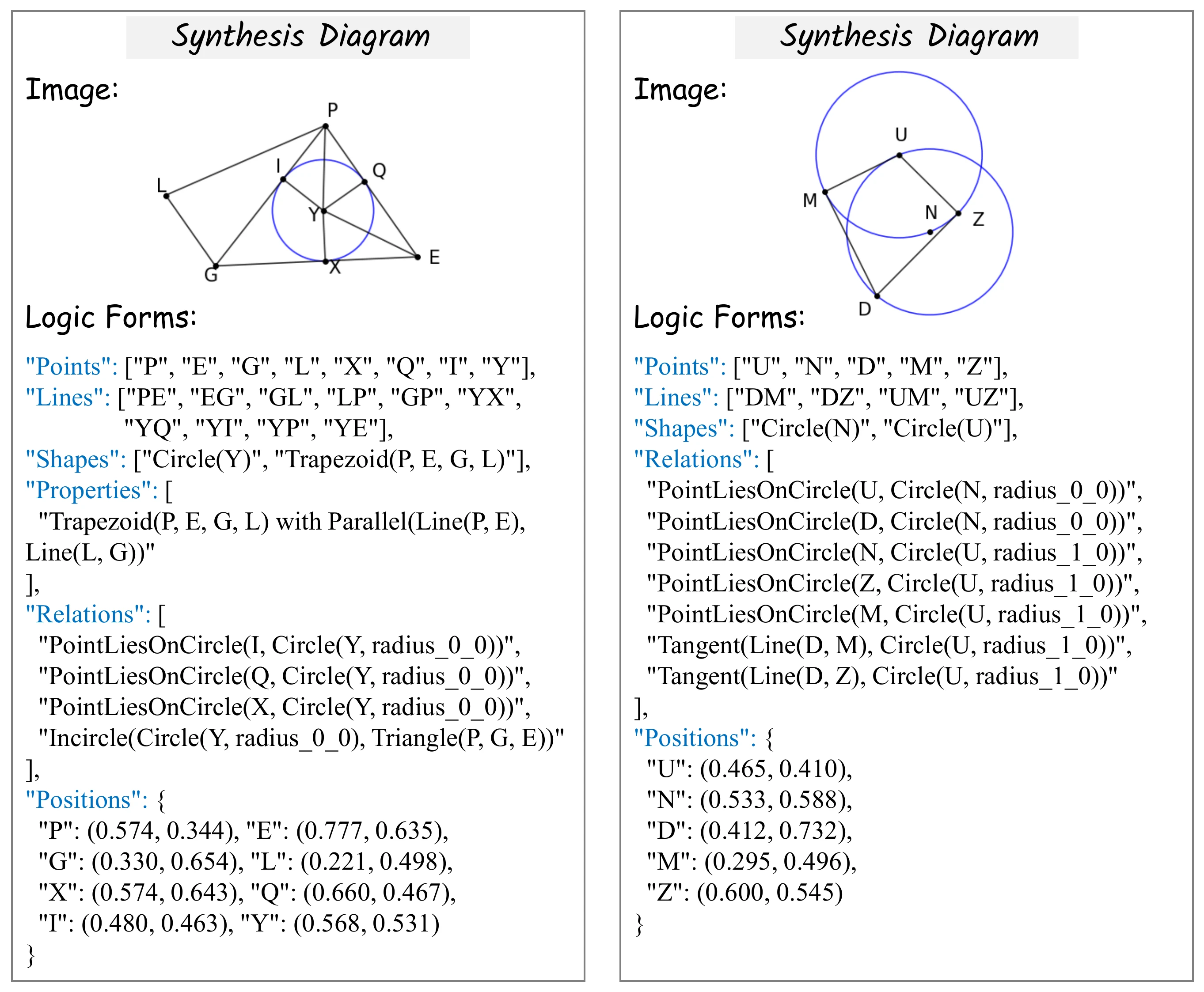
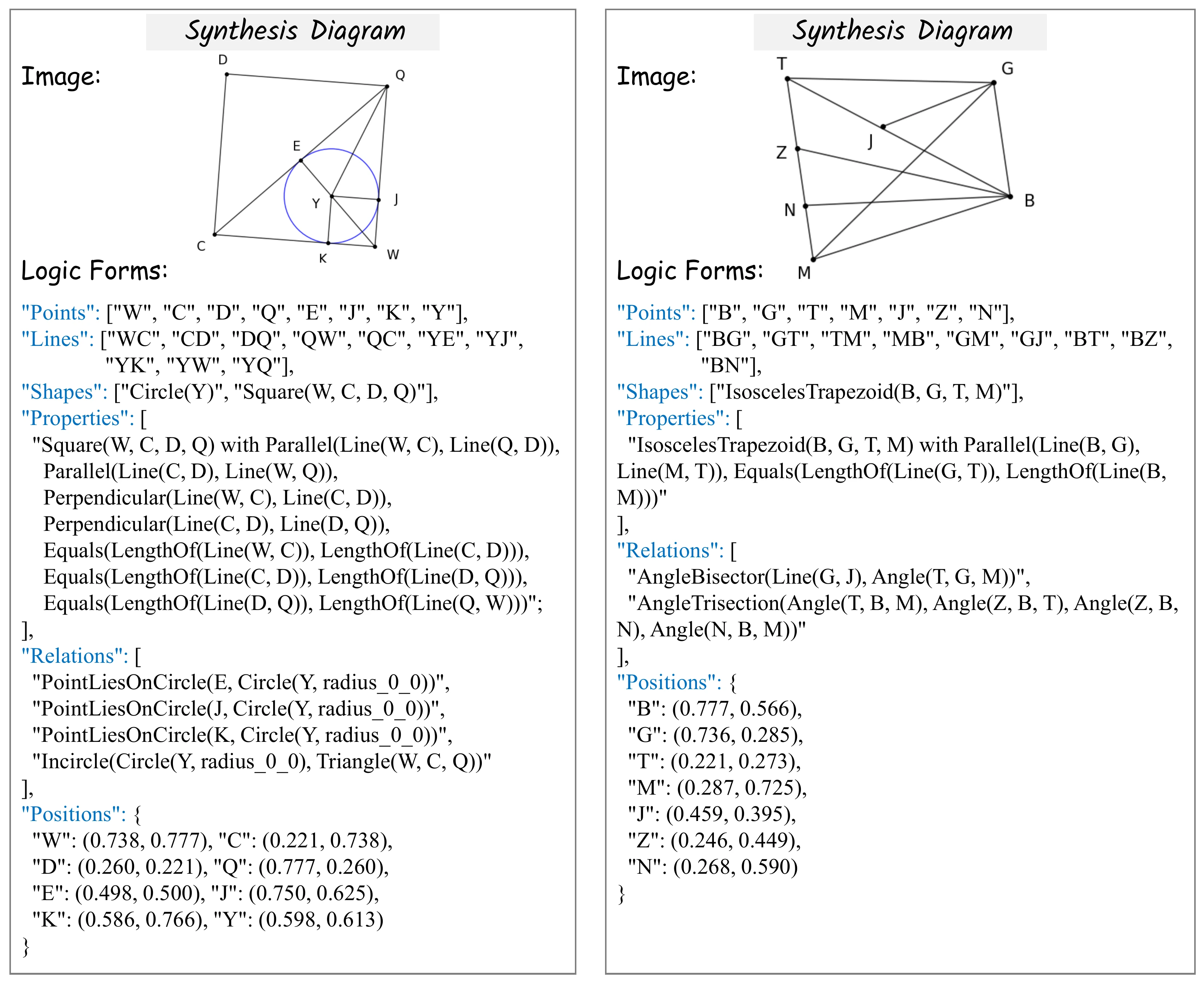
Our symbolic representations consist of compositional geometric primitives organized in a hierarchy: Points → Lines → Shapes → Shape Indicators → Relations.
Our symbolic encoder demonstrates strong cross-domain generalization, extending beyond geometric diagrams to electrical circuits and chemical structures.
After fine-tuning on perception tasks, our model exhibits emergent cross-lingual transfer: formal logic forms are automatically translated into fluent natural-language chain-of-thoughts without any explicit CoT supervision.
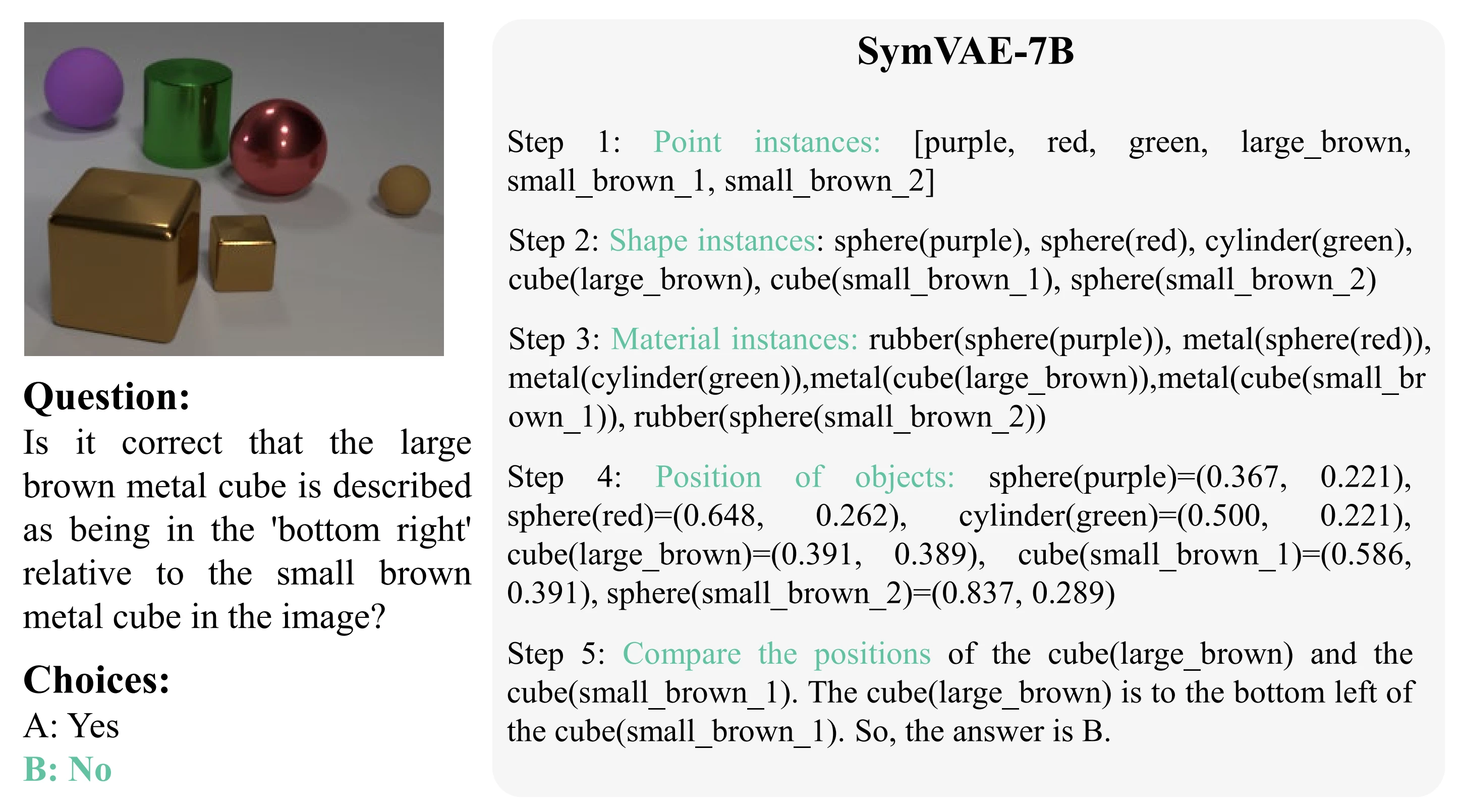
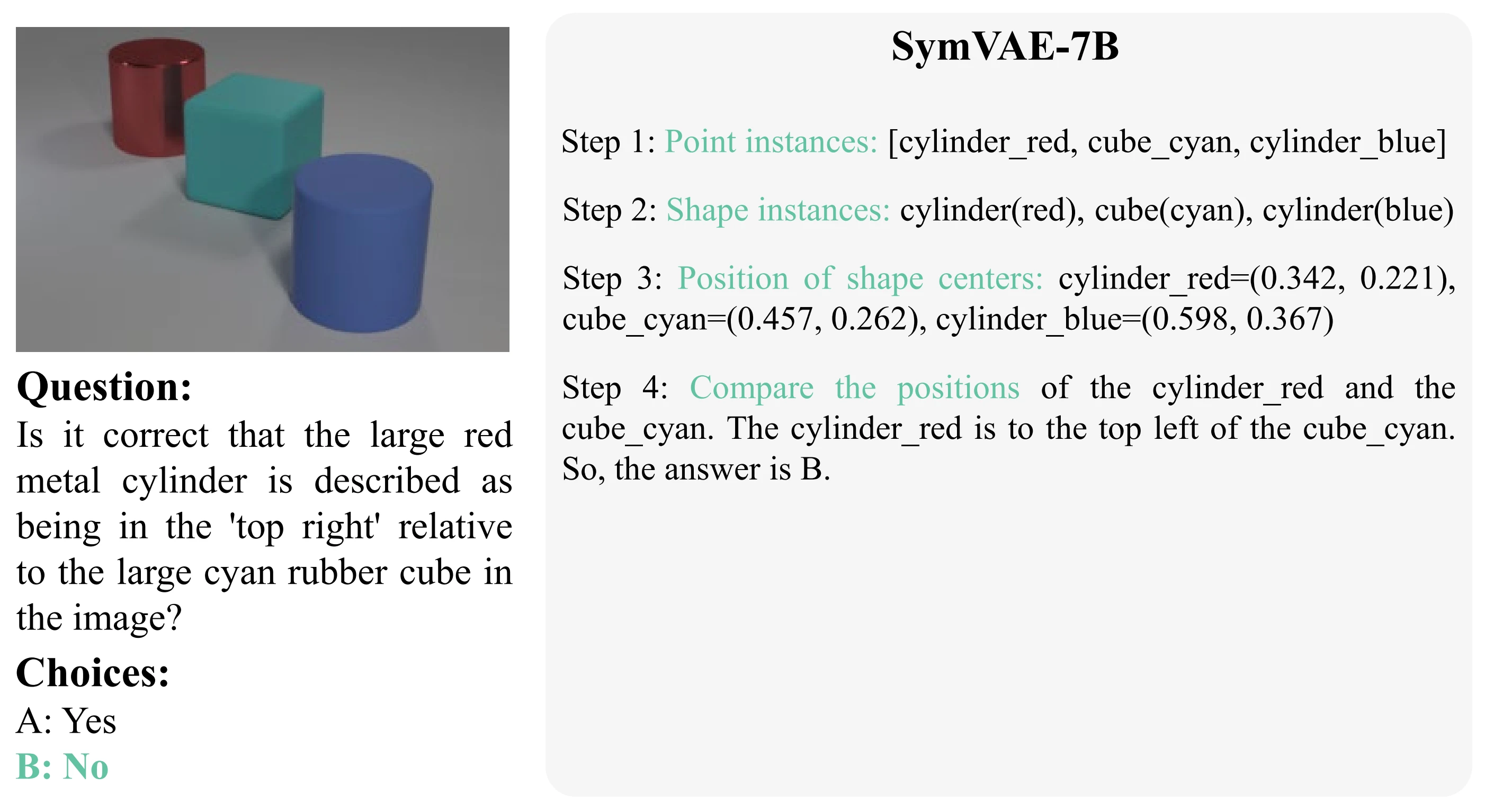
Although trained only on 2D geometric diagrams, the model automatically adapts point primitives to 3D scenes, enriching them with attributes such as object shape, color, and material.
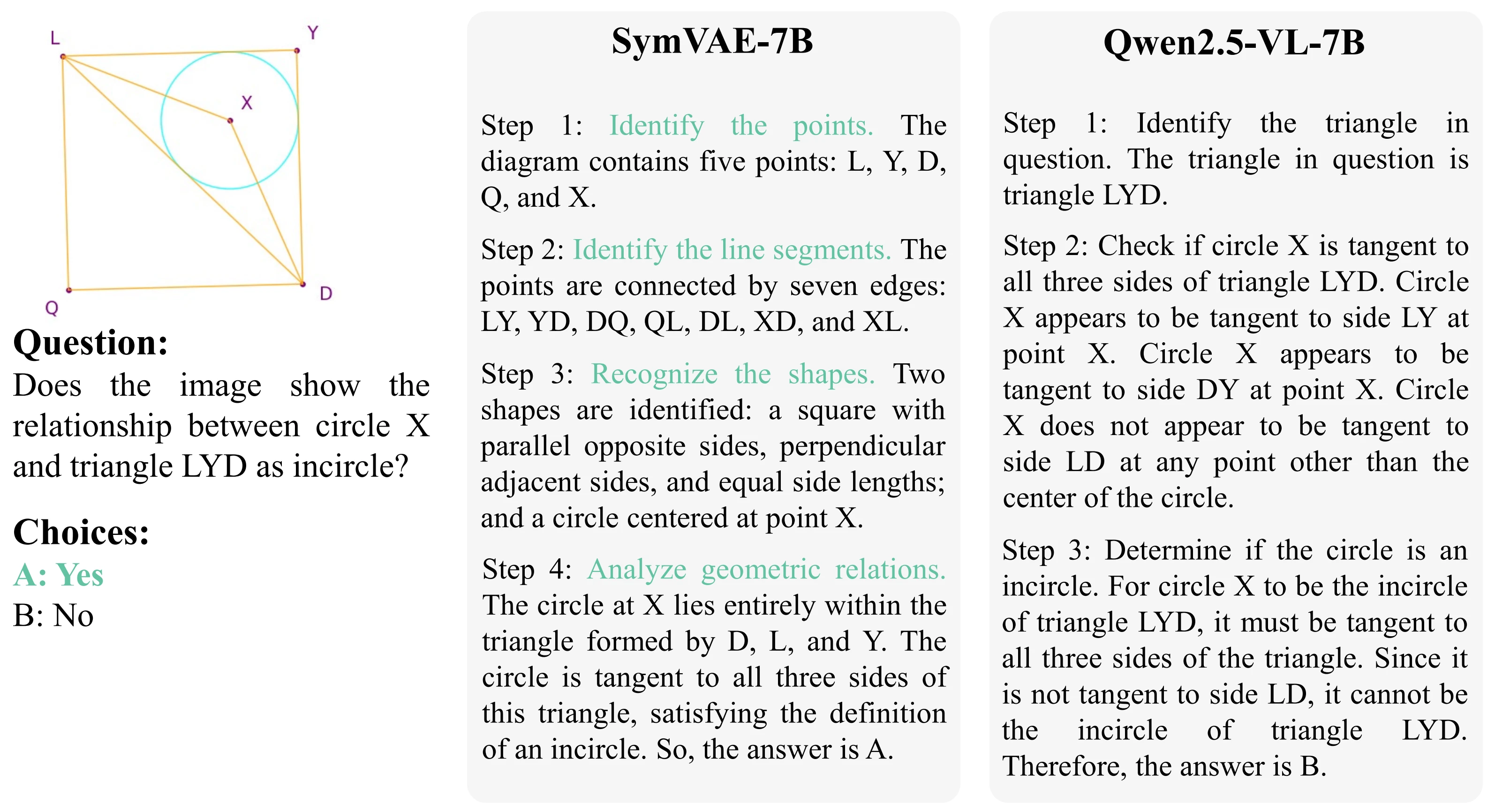
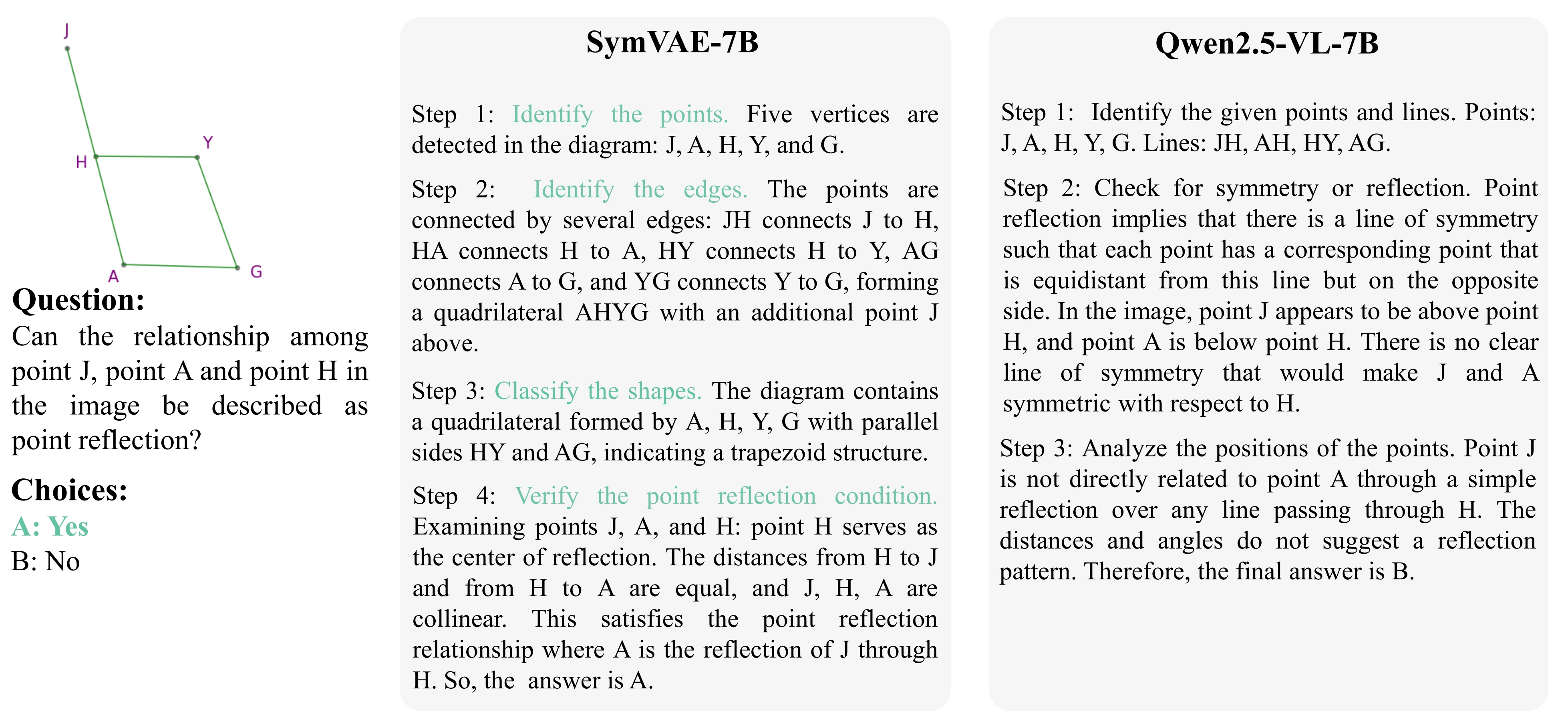
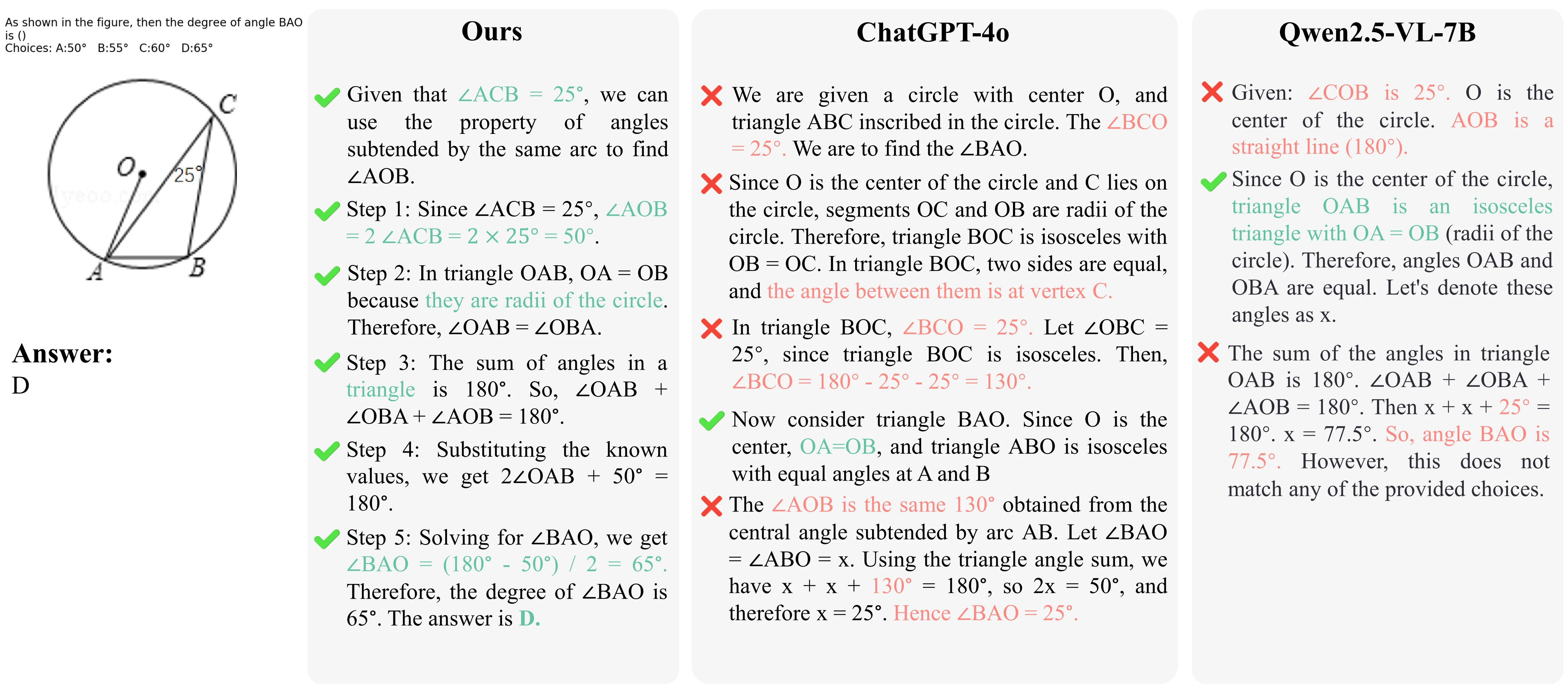
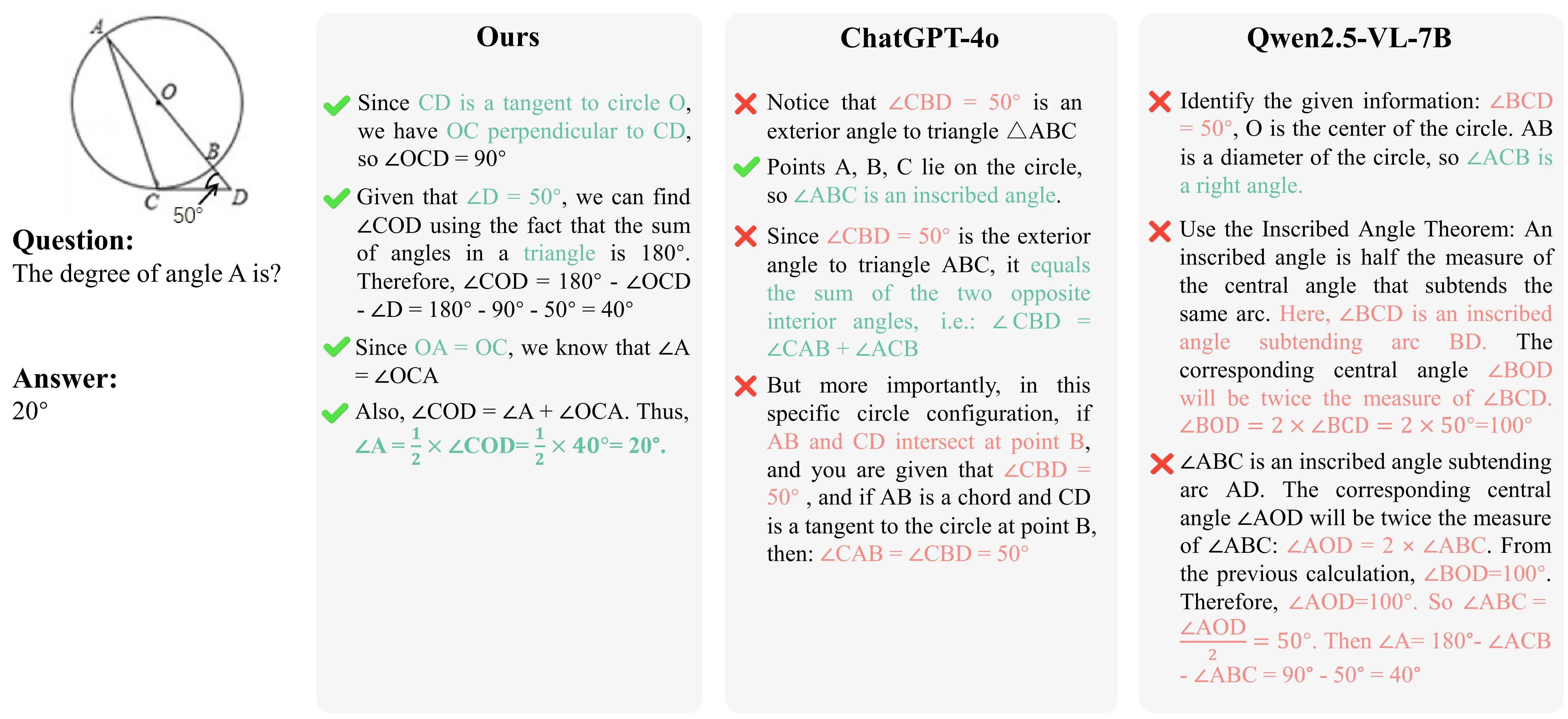
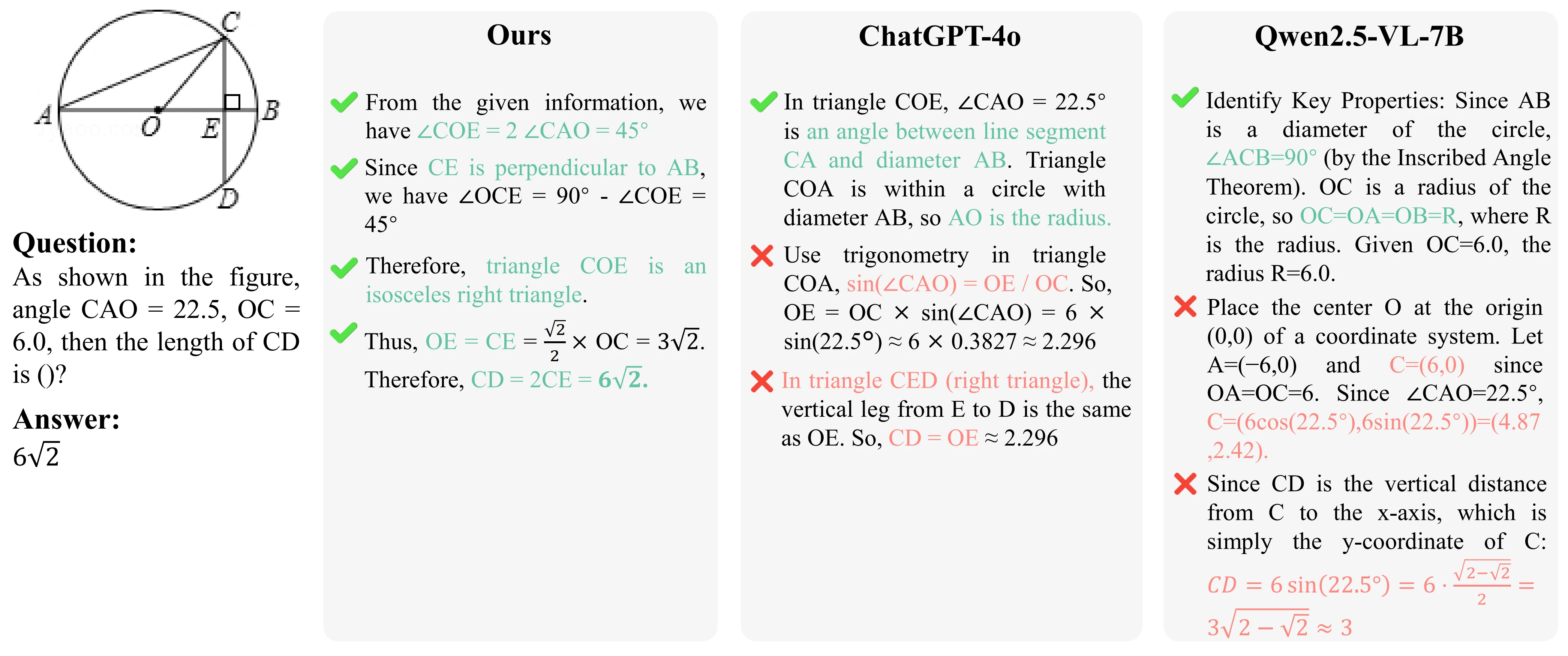
Our model produces correct reasoning chains grounded in accurate visual perception.
@article{zhang2025symhpr,
title={Hierarchical Process Reward Models are Symbolic Vision Learners},
author={Zhang, Shan and Chen, Aotian and Zou, Kai and Gu, Jindong and Xue, Yuan and van den Hengel, Anton},
journal={arXiv preprint arXiv:2512.03126},
year={2025}
}